Some Hybrids Barely Drive on Electricity, Others Barely Use Fuel
Published on 22nd December 2025 by Simon Fearby
Calling everything a hybrid hides the fact that some still burn fuel constantly, while others rarely do.
Quick Hybrid Breakdown
- MHEV (Mild Hybrid Electric Vehicle): an engine car assisted by electricity, but never driven by it alone.
- HEV (Hybrid Electric Vehicle): an engine car that can briefly drive on electric power at low speeds.
- PHEV (Plug-in Hybrid Electric Vehicle): an engine car that can behave like an EV when charged.
- EREV (Extended-Range Electric Vehicle): an EV that happens to carry an engine to generate electricity.
- REEV (Range-Extended Electric Vehicle): another name for an EREV; an EV with a generator-style engine.
- BEV (Battery Electric Vehicle): an EV with no engine at all.
The Clean Classification Rule
Ignore badges and marketing. The single question that separates these drivetrains is: can the petrol engine mechanically drive the wheels?
| Drivetrain Type | ICE Engine | Traditional Gearbox | Driveshaft / Axles | Engine Can Mechanically Drive Wheels | Primary Wheel Propulsion |
|---|---|---|---|---|---|
| MHEV Mild Hybrid |
Yes | Yes | Yes | Petrol engine | Petrol engine |
| HEV Full Hybrid |
Yes | Yes | Yes | Yes | Petrol engine (electric assists) |
| PHEV Plug-in Hybrid |
Yes | Yes | Yes | Yes (most designs) |
Mixed: engine or electric |
| EREV / REEV Extended-Range EV |
Yes | No (no traditional gearbox) |
No (no engine torque path) |
No | Electric motor only |
| BEV Battery EV |
No | No | No | No | Electric motor only |
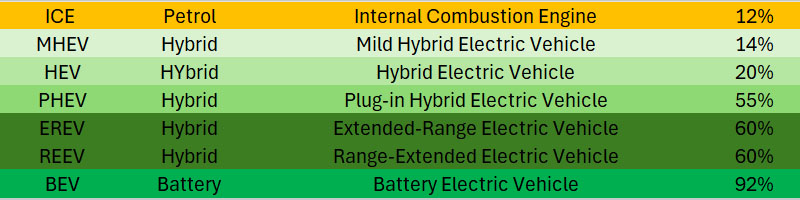
Colours indicate environmentally friendly propulsion
Rule of thumb: if the engine can directly drive the wheels, it is not a pure EV architecture - regardless of how large the battery is or whether it plugs in.
Some Hybrids Barely Drive on Electricity, Others Barely Use Fuel
“Hybrid” isn’t one technology anymore. Mild hybrids, full hybrids, plug-ins, range extenders, and pure EVs behave very differently. This table is a practical cheat-sheet for ICE owners who just want facts.
| Type / Acronym | What it is (plain English) | Can drive on electricity alone? | Typical EV-only range | Plug-in charging? | Mechanical Complexity | Maintenance | Energy use (typical) | Energy cost @ AU prices $1.90/L petrol, $0.14/kWh |
Est. service cost / year (routine service only) |
Fuel Efficiency | Common cars (manufacturer links) |
|---|---|---|---|---|---|---|---|---|---|---|---|
| ICE Internal Combustion Engine |
Traditional petrol/diesel only. | No | 0 km | No | High | Moderate | ~7.5–9.5 L/100km |
$14.25–$18.05 / 100km
$2,138–$2,708 / year (15,000km)
|
$400–$800 | 12% | |
| MHEV Mild Hybrid |
Small battery + motor assists the engine (start/stop, smoothing, small boost). Usually can’t “EV drive” in a meaningful way. | No (not meaningfully) | 0–1 km | No | High | Moderate | ~6.5–9.0 L/100km |
$12.35–$17.10 / 100km
$1,852–$2,565 / year
|
$450–$900 | 14% | Note: MHEV availability varies by trim/market. |
| HEV Full Hybrid / “Self-Charging” |
Engine + motor; can do short low-speed electric driving. No plugging in; battery charges from driving/braking. | Yes (short bursts) | ~1–5 km (conditions vary) | No | High | Moderate | ~4.5–6.0 L/100km |
$8.55–$11.40 / 100km
$1,282–$1,710 / year
|
$450–$900 | 20% | |
| PHEV Plug-in Hybrid |
Bigger battery than HEV. Can do real EV driving when charged, but still has a full engine drivetrain for longer trips. | Yes (properly) | ~30–100 km | Yes | Moderate | Moderate |
EV mode: ~18–22 kWh/100km
Hybrid mode: ~5.5–7.0 L/100km
|
EV mode: $2.52–$3.08 / 100km → $378–$462 / year
Hybrid mode: $10.45–$13.30 / 100km → $1,568–$1,995 / year
Real cost depends heavily on how often you plug in. |
$500–$1,000 | 55% | |
| EREV Extended-Range EV / Range-Extended EV |
Drives like an EV (motor drives the wheels). Small engine is mainly a generator to make electricity when the battery is low. | Yes (EV drivetrain) | ~60–200+ km (varies) | Usually yes | Moderate | Moderate |
EV mode: ~18–22 kWh/100km
Generator mode: ~6.5–8.0 L/100km (equivalent)
|
EV mode: $2.52–$3.08 / 100km → $378–$462 / year
Generator mode: $12.35–$15.20 / 100km → $1,852–$2,280 / year
|
$500–$1,000 | 60% | Note: “EREV/REEV” naming is inconsistent globally; check the drivetrain description. |
| BEV Battery Electric Vehicle |
Battery + motor only. No petrol/diesel engine. | Yes (only) | ~250–750+ km | Yes | Low | 3–4 | ~15–20 kWh/100km |
$2.10–$2.80 / 100km
$315–$420 / year
|
$150–$400 | 92% |
Mechanical Complexity Rating
- Low - few moving parts, simple power path
- Moderate - multiple systems interacting
- High - many moving parts, tightly coupled systems
Parts a BEV does NOT have
- Air intake system
- Air filter box and ducting
- Turbocharger or supercharger
- Intercooler and boost plumbing
- Throttle body
- Fuel injectors
- Fuel rail and high-pressure fuel pump
- Spark plugs or glow plugs
- Ignition coils
- Cylinder head
- Valves, valve springs, camshafts
- Timing belt or timing chain
- Pistons and piston rings
- Connecting rods
- Crankshaft
- Engine block
- Engine oil system (oil pump, oil filter, sump)
- Radiator dedicated to engine cooling
- Exhaust manifold
- Catalytic converter
- Diesel particulate filter (DPF)
- Muffler and exhaust piping
- Gearbox or multi-speed transmission
- Torque converter or clutch pack
- Driveshaft
- Differential (traditional ICE-style)
- Fuel tank
- Fuel lines
- Evaporative emissions system (charcoal canister, purge valves)
Parts a BEV DOES have
- Electric traction motor (front, rear, or both) Rotator and Sator
- Single-speed reduction gear
- Inverter (DC ↔ AC motor control)
- Motor controller / power electronics module
- Onboard charger (AC charging)
- DC fast-charge interface and control hardware
- High-voltage battery pack
- Battery management system (BMS)
- High-voltage contactors and safety disconnects
- High-voltage cabling (orange HV looms)
- DC-DC converter (high voltage → 12V)
- Low-voltage (12V) battery
- Vehicle control computer(s)
- Thermal management system (battery, motor, inverter cooling)
- Heat pump or resistive cabin heater
- Regenerative braking system (motor-based)
- Brake-by-wire control module
- Charge port and locking mechanism
- Insulation monitoring and high-voltage safety systems
Moving Parts Compared
Approximate Moving Parts by Drivetrain Type
| Drivetrain Type | Primary Propulsion |
Approx. Moving Parts (Core Propulsion) |
Ancillary Serviceable Moving Parts (Pumps, generators, accessories) |
Where the Complexity Comes From |
|---|---|---|---|---|
| ICE | Petrol / diesel engine | ~100–120+ | ~20–30 | Full combustion engine with valvetrain, timing system, lubrication, cooling, fuel, and exhaust systems |
| MHEV | ICE (electric assist) | ~100–130+ | ~25–35 | Full ICE drivetrain plus starter-generator, belt drive, power electronics, and additional cooling |
| HEV | ICE + electric motor | ~110–150+ | ~30–40 | ICE drivetrain plus traction motor, power-split device, regenerative braking hardware, and hybrid cooling systems |
| PHEV | ICE or electric motor | ~130–180+ | ~35–45 | Two overlapping propulsion systems: full ICE drivetrain plus EV motor, charging hardware, and duplicated cooling loops |
| EREV / REEV | Electric motor only | ~5–10 | ~15–25 | EV propulsion with a simplified generator engine, steady-state operation, and limited mechanical coupling |
| BEV | Electric motor only | ~3–8 | ~10–15 | Single electric motor, reduction gear, pumps, fans, thermal management, and power electronics |
Notes: figures are approximate and represent order-of-magnitude comparisons. “Ancillary serviceable parts” move and require maintenance but do not mechanically drive the wheels.
Fuel Efficiency
How much of the energy you buy becomes motion? ICE wastes heaps of energy as heat and noise.
Efficiency % depends on tank/battery → wheels (drivetrain efficiency) or fuel/energy source → wheels (overall wasted energy story), including charging losses, elevation rise and fall.
Scenario assumptions:
- Driver does 80 km/day
- Charges at home whenever possible
- PHEV/EREV are plugged in nightly
Typical real-world overall efficiency (BEV = Tesla), not lab numbers.
Assumptions (so you can sanity-check the numbers)
- Annual driving distance: 15,000 km/year
- Fuel price: $1.90 per litre
- Electricity price: $0.14 per kWh (But can be $0.08 per kWh or Free if you have Solar.)
- Energy use ranges are “typical real-world ballparks” (vehicle, tyres, speed, temperature, and driving style change everything).
- Service cost is routine scheduled servicing only (excludes tyres, brakes, insurance, rego, repairs, and battery degradation).
- PHEV/EREV cost depends massively on how often you plug in (the table shows EV-mode cost vs fuel/generator-mode cost).
More to be added over time.